Finding your stance
Start with a stance that feels comfortable and gives you a steady base. You can stand more sideways or at an angle to the board. Find a position where you can keep your balance without rocking or swaying as you throw.
Adjust your position along the throwing line so your throwing arm lines up naturally with the centre of the board. You should be able to bring the dart back and send your hand towards the target without twisting your body or forcing your shoulder into position. Keep your feet in place and avoid leaning so far forward that you lose your balance.
Your throwing technique
Set aside a short part of your practice just for the movement. For these few minutes, pay less attention to the score and more attention to how the throw feels.
Start by throwing straight
As a beginner, focus first on throwing straight. Aim for the large single 20 area rather than chasing the treble every time. Look for a relaxed movement without sudden jerks or sideways twists, followed by a smooth follow through towards the target. This gives you a simpler movement to repeat as you work on keeping your darts in line.
Let the arm follow through
Let your hand continue towards the target after you release the dart. Finish with the arm extended and the hand relaxed. As a drill, exaggerate the finish a little by holding that position for a moment before reaching for the next dart. Let it extend naturally rather than forcing the elbow to lock. Imagine reaching out to place the dart into the board.
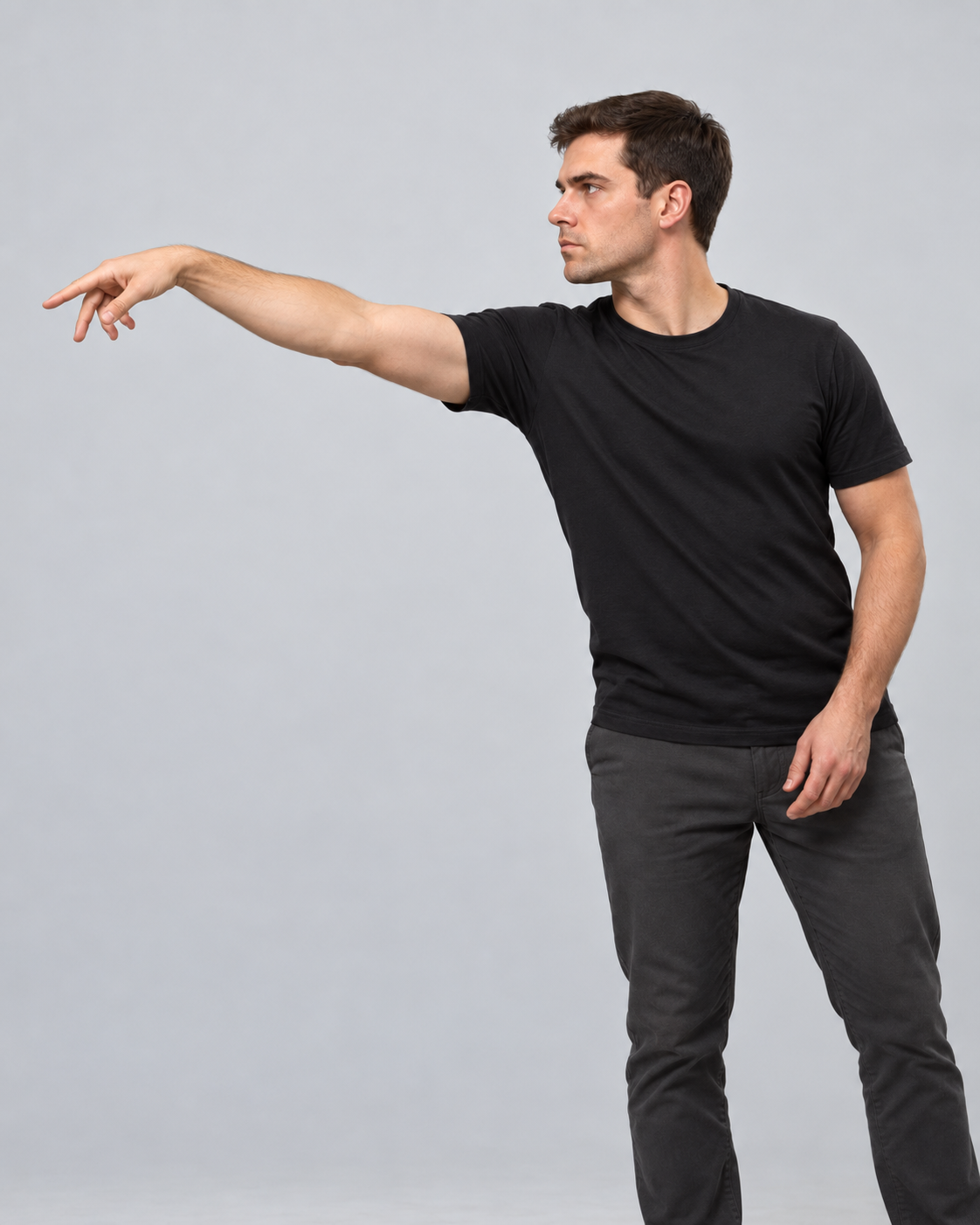
Avoid dropping your elbow on the drawback
As you bring the dart back, try to keep your elbow at a consistent height rather than letting it drop. During the forward throw, the upper arm and elbow may rise a little as the arm extends. Let that happen naturally without forcing a lift or trying to hold everything rigid.
Let the wrist follow through too
As a beginner, you do not need to spend too much time thinking about your wrist. Aim to keep it relaxed and let it follow through naturally with your hand after release. Avoid forcing a flick or holding the wrist stiff. Focus on an easy movement of the whole arm first.
Look for an easy, relaxed movement
Keep your grip, arm and shoulder as relaxed as you can while staying in control. The feeling you are looking for is a throw that takes very little effort. Avoid snatching at the release or trying to push the dart harder.
Keep your stance balanced and your head and body still as you throw. Work on one thing at a time. It is easier to notice what helps when you are not changing your grip, stance and arm movement all at once.
Watch and review
Watch a smooth throw
Luke Humphries and Raymond van Barneveld are useful players to watch for a smooth throwing action. Look at their rhythm, how the forearm moves, and how the hand continues after release.
You do not need to copy their grip or stance exactly. Use them as examples of a relaxed, consistent movement, then find what feels natural for you.
Film yourself
A throw can feel one way and look quite different on video. Record a few visits from the side, with your hand, elbow, shoulder and head visible. A second clip from the front can help you check your balance and sideways movement.
You can use the Championship Darts Video companion, or simply use your phone. For this exercise, point the camera at your throwing action so you can see the movement clearly. In Scoring Training, for example, you can choose which throws to save after you have thrown by pressing REC. Record both good and bad throws so you can compare them. When the session is over, you can download the video file to your device.
Watch at normal speed first, then slow it down. Compare the same part of the movement with a professional throw, and ask yourself:
- Does my elbow drop before I release the dart?
- Does my hand continue towards the target after release?
- Do my head and body stay still?
- Do all three darts have a similar rhythm and movement?
- Can I see tension, a pause or a sudden jerk?
- Does my wrist stay relaxed and follow through naturally after release?
Choose one thing to work on, practise it for a few sessions, and film again. Keep an earlier clip so you can compare your own progress too.
Practice games
Different games give you different things to work on. Mix finishing practice with scoring and a game where you move around the board.
301 against the CPU: practise finishing
Start with 301 and always use double out. Try a few different CPU opponents until you find a level that gives you a close game. You want a chance to win, with enough pressure to make the doubles matter.
For this exercise, leave the averages alone. When you are learning, it is normal to spend quite a few darts on a double before hitting it. That brings your match average down, but those darts are useful practice. Focus on finding a finish and giving yourself another chance at the double.
Use these legs to practise counting and learning your checkout routes too. Even when the app suggests a finish, try to work it out yourself first. Learn the common finishes by heart, including what you have left if you hit a single instead of the double or treble you wanted.
In this 301 exercise, the checkout is more important than scoring your way down from 301. Give yourself time to think about the finish. Work on pure scoring separately in Scoring Training or similar practice games.
Scoring Training: 120 darts
Switch to a session of 120 darts in Scoring Training. Here, your average is the number to follow. There is no double at the end of a leg to think about, so you can concentrate on scoring and repeating your throw.
Compete against yourself. Try to beat your previous average, and keep the session length the same so you can compare results fairly. A personal best is a nice target, but look at several sessions too. One difficult day does not mean you are going backwards.
10 to Bull: a change of target
Add a game of 10 to Bull for variety. It gives you different targets to aim at and a score to try to improve. Play a round, note your result, and see if you can beat your own record next time.
Give yourself something to play for. Create a league with CPU players, friends, or a mix of both at roughly your level. Having a league to try to win can make practice more inspiring and give you a reason to look forward to the next match.
A simple session
If you are unsure where to start, try this. Adjust the amount to suit the time and energy you have.
- A few minutesWarm up, then focus on a relaxed throw and a comfortable follow through.
- 120 dartsPlay Scoring Training and compare your average with previous sessions.
- A few legs of 301Play the CPU with double out. Concentrate on finishing, without worrying about your average.
- Have fun!Play games that inspire you, whether that is 10 to Bull, a tournament or a league of your own.
What would help you?
Let us know through Feedback in the app. We are building this with our community, and we would love to hear your ideas for making the app even better.
Further watching and reading
Red Dragon: simple tips to improve your game includes advice on a stable stance and throwing alignment.
Luke Humphries and Mark Webster: Your Darts Journey covers stance, grip and follow through.
Wayne Mardle on Raymond van Barneveld’s throwing action is another useful reference.
DartsUK: common throwing mistakes discusses follow through, elbow movement and a stable stance.